
Cart
0
You may also like



For most people, no. Graduated compression socks are daytime garments: they work by helping the leg veins against gravity, and when you lie down that problem largely disappears, so the mechanism is not doing much. Skin also benefits from an overnight break from constant pressure. There are real exceptions — after certain vein procedures, in lymphoedema care, in hospital, and in advanced venous disease — but every one of them involves a clinician assessing your legs and giving a specific instruction. If what you actually want is warm feet and gentle, even contact overnight, a non-binding sock gives you that without a pressure gradient acting on your circulation for eight hours.
Key Takeaways
You bought compression socks because your legs ache by evening, or they swell on long days, or someone recommended them after a flight. They help. So a reasonable thought follows: if they help during the day, surely leaving them on overnight helps more. It is one of the most common questions people ask about compression wear, and the answer that most clinicians give is more interesting than a flat yes or no.
The short version is that for most healthy people, sleeping in compression socks is unnecessary rather than dangerous — and for a specific group of people it is genuinely inadvisable. There is also a real set of situations where a healthcare provider will specifically ask you to wear compression overnight. This article walks through the reasoning, what the gravity argument actually means, who should not do it, what to wear at night instead, and how to talk to your provider about it.
This is general information, not a recommendation for your situation. Compression is a graded medical device and the right answer depends on your circulation, your skin, and your diagnosis.
A graduated compression sock applies its strongest pressure at the ankle and gradually less pressure moving up the calf. That gradient is the whole point. Blood in your leg veins has to travel upward against gravity, and it relies on two things to get there: one-way valves inside the veins, and the calf muscle squeezing the deep veins each time you take a step — often described as the calf muscle pump.
External compression supports that system. By narrowing the vein slightly, it helps the valves meet properly and gives the muscle pump something to push against. Cleveland Clinic's overview of compression therapy describes the general mechanism and the range of situations where it is used clinically.
Compression is measured in millimeters of mercury (mmHg) and sold in bands: roughly 8–15 mmHg for mild everyday support, 15–20 mmHg for moderate, 20–30 mmHg and above as medical grades usually recommended by a clinician. The higher the number, the more the sock is doing — and the more the question of when to take it off matters.

Here is the core reasoning behind the standard advice. Compression exists to counteract gravity. When you are upright, blood is being pulled downward the length of your leg and your veins are working against that pull all day. When you lie flat, your legs are roughly level with your heart. The gravitational load that compression was designed to offset largely disappears.
Cleveland Clinic's discussion of whether you can sleep in compression socks makes exactly this point: the benefit is tied to being upright and moving, and lying down removes the effect the sock was countering. That is why the standard instruction is to put compression on in the morning before swelling starts, and take it off before bed.
Notice what that argument is and is not. It is an argument that overnight wear is usually pointless for a healthy person. It is not an argument that overnight wear is inherently harmful. Those are different claims, and the distinction matters if you have fallen asleep in yours once and are now worried.
The most practical reason, and the one most often overlooked. Skin under compression for 24 hours a day stays slightly warm, slightly damp, and constantly under mechanical pressure. Overnight is the natural window to remove the sock, wash and dry the leg, apply moisturizer, and let the skin recover. Dry, cracked, or irritated skin under a compression garment is a common and avoidable problem.
During the day you feel a sock that has rolled at the top or bunched behind the knee, and you fix it. Asleep, you do not. A rolled band at the top of a compression sock becomes a narrow tourniquet-like ring — precisely the opposite of the smooth gradient the garment is designed to deliver. This is the single most common way overnight compression causes an actual problem.
If you have reduced sensation in your feet — from diabetes-related nerve changes, neuropathy from another cause, or any condition affecting feeling below the knee — you may not register that a sock is too tight, has rolled, or is rubbing. Twelve waking hours with reduced sensation is a manageable risk. Twenty-four hours is a larger one.
It helps to think of compression as something with a prescribed amount rather than a comfort item. More hours is not automatically better, in the same way that more of a medication is not automatically better. If a provider told you to wear 20–30 mmHg during the day, that instruction has a shape to it. Doubling the wear time is a change worth asking about rather than assuming.
Some situations move this from "unnecessary" to "please do not." Talk to a clinician before wearing compression overnight — or in some cases at all — if any of the following apply to you:
Against all of the above, there are real clinical situations where a provider will ask for compression at night. This is worth stating clearly, because people sometimes read general advice and stop following specific instructions they were given.
The pattern across all four: these are supervised situations with specific garments and defined durations. If you are in one of them, your provider's instruction is the one that applies, not a general article.
A common and reasonable question. Falling asleep in your compression socks for an hour on the sofa is not something to be alarmed about. The concerns above are cumulative — skin needing recovery time, unnoticed rolling, hours of unmonitored pressure — and a short nap does not accumulate much of any of them. If it happens occasionally, take them off when you wake up and carry on.
Many people wearing compression during the day still want something on their feet at night, whether for warmth, comfort, or dry skin. This is where non-binding socks are the right tool, and they are a genuinely different product from compression.
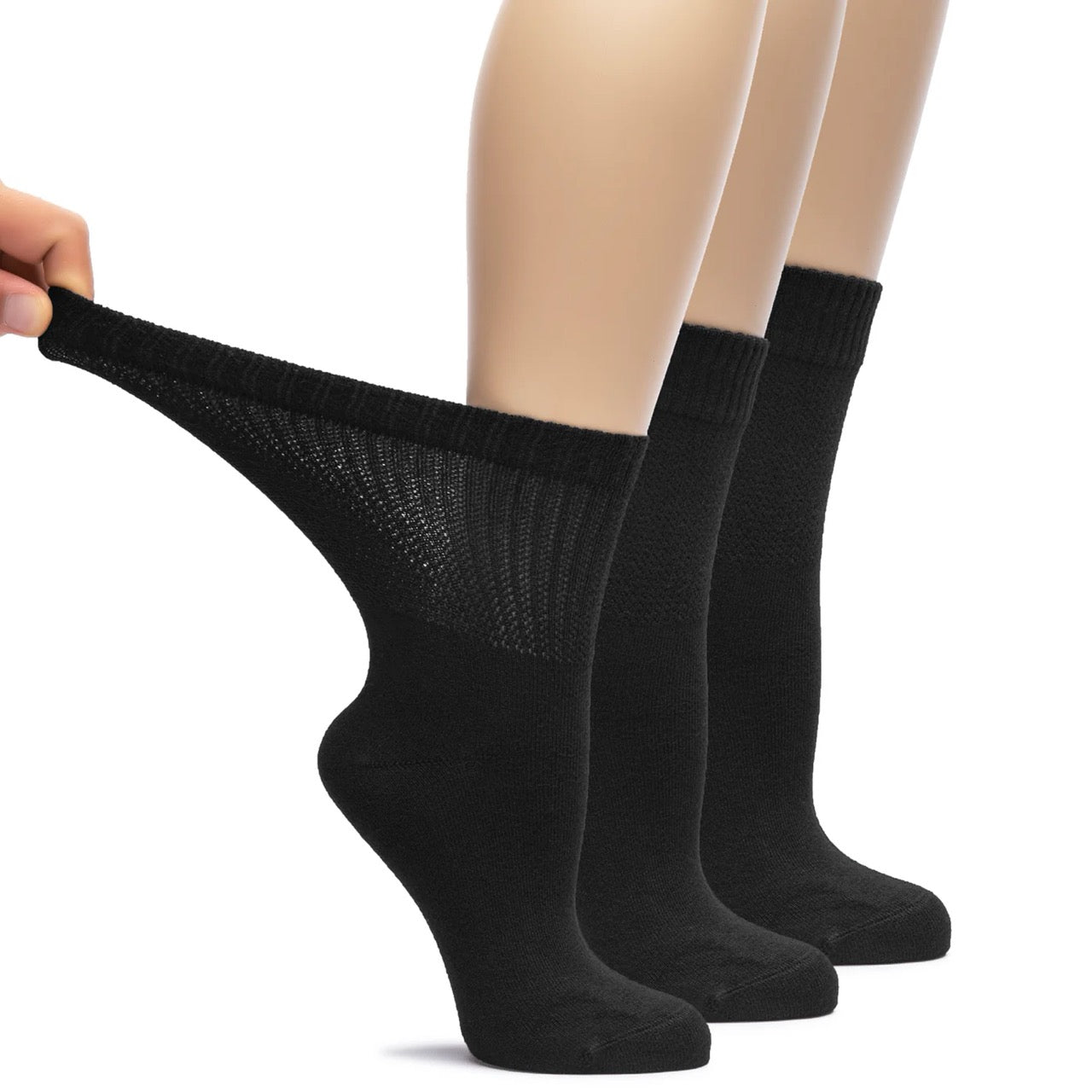
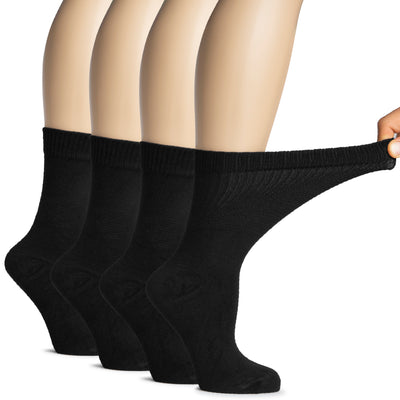
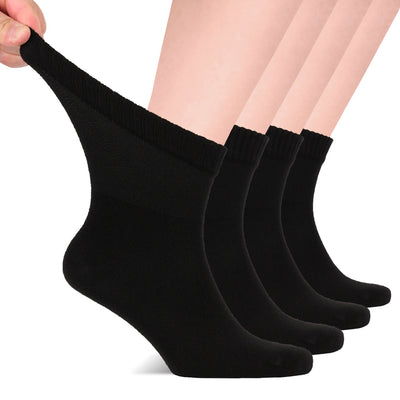
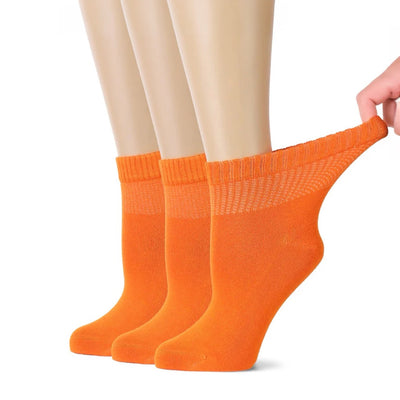
A non-binding sock has no graduated pressure gradient. Instead of an elastic band that grips, it uses a wider, gently stretched cuff designed to stay up without constricting — so the sock stays where you put it and does not leave an indentation ring around the leg. That is exactly the property you want for a garment worn while lying still for eight hours. We cover the underlying design in what non-binding diabetic socks are and how non-binding socks support circulation.
What to look for in a night sock:
The women's bamboo thin crew socks and men's lightweight bamboo ankle socks are both built along these lines, and the wider non-binding diabetic sock collection covers other heights and fibers. If your interest in night socks is mainly about cold feet or sleep quality, our piece on wearing socks to bed goes into that separately — and if the reason you are awake is that your legs will not settle, socks for restless legs at night deals with that specific problem.
If the impulse behind sleeping in compression is that your daytime wear does not seem to be doing enough, the more productive move is usually to fix the daytime routine rather than extend the hours.
Our article on compression socks and long flights covers a related question — what compression can and cannot do during extended immobility — and compression versus non-binding for varicose veins compares the two categories directly.
Whatever you decide about nighttime wear, take compression off and contact a healthcare provider if you notice numbness or tingling that does not resolve within minutes of removal, skin that has turned pale, blue, or unusually cold, increasing pain rather than relief, any new open area or blister, or deep indentations that are still visible an hour after taking the sock off. Those are signals that the fit or the compression level is not right for your leg.
For most healthy people, an occasional night is unlikely to cause harm — the usual concerns are about repeated 24-hour wear rather than a single occasion. The situation is different if you have peripheral artery disease, reduced sensation in your feet, or fragile skin, in which case it is worth mentioning to your provider. If you wake up with numbness, discoloration, or pain, take them off and get advice.
Two main reasons. Compression is designed to counteract gravity while you are upright, and lying flat already removes most of that gravitational load, so the sock has much less to do. And skin benefits from a daily break from pressure, warmth, and moisture — overnight is the natural window for washing, drying, and moisturizing the leg.
Yes. Venous leg ulcers, lymphedema management, some post-surgical protocols, and hospital care can all involve overnight compression — usually with garments made specifically for night wear rather than daytime socks. Those are provider-directed situations, and if you have been given that instruction, follow it over general advice.
Non-binding socks with no compression rating, a seamless toe, a soft cuff that stays up without leaving a mark, and a breathable fiber such as bamboo viscose or cotton. Keep them lightweight so your feet do not overheat under bedding. The point is coverage and warmth without applied pressure.
Significant, persistent swelling is a reason to be assessed rather than a reason to extend wear time on your own. Swelling has many possible causes, and the appropriate compression level and schedule depend on which one applies to you. Bring the question to your provider — that conversation is more likely to help than doubling the hours.
For most people, compression socks are a daytime tool. They work by opposing gravity and supporting the calf muscle pump, and lying down does much of that for free. Take them off at night, give your skin the break, and wear a soft non-binding sock instead if you want something on your feet. The exceptions are real — ulcers, lymphedema, post-surgical instructions — but they come with specific garments and specific guidance from someone who has looked at your legs.
This article is for general information and is not medical advice. Talk to your healthcare provider about your own feet.
For most people the answer is no, and that is the standard clinical advice. Compression socks support the leg veins against gravity while you are upright; once you lie down your legs are level with your heart and that mechanism is largely idle. Your skin also benefits from a break from constant pressure. Unless a healthcare provider has specifically told you to wear them overnight, take them off before bed.
For most healthy people, wearing a light compression sock overnight occasionally is not dramatic. The real concern is narrower: anyone with reduced arterial circulation, which is frequently undiagnosed, and anyone with reduced sensation in their feet who might not notice a sock that has rolled into a tight band while they slept. Both are reasons to ask your provider before making it a habit.
Usually after vein surgery or ablation, as part of lymphoedema management with a separate night-time garment, in hospital for patients who are not mobile, and sometimes in advanced chronic venous insufficiency. In every case a clinician has assessed the individual leg and set the regime.
A non-binding sock. The design is the opposite of compression: even, gentle contact with no pressure gradient, a top that stays up through knit structure rather than tension, and a flat or seamless toe so nothing presses into the skin overnight. Choose a breathable fibre, because bedrooms and duvets are warm and a sock that holds moisture turns clammy.
Probably not, and it may not be addressing the right problem. Ordinary swelling that builds through the day resolves by itself when you lie flat, which is why compression is not needed in bed. Swelling that is still there when you wake, or that appears suddenly in one leg, is a different signal and worth raising with your healthcare provider.
Discover All Hugh Ugoli Socks
Shop All Socks


