Cart
0
You may also like


People managing lymphedema in the lower legs and feet encounter a particular challenge when it comes to socks: the sock that works for everyone else may actively make their condition worse. Standard socks with tight elastic cuffs restrict fluid movement at the ankle, exactly where lymphedema management most needs unimpeded flow. The wrong sock worn daily can undo the compression therapy gains from a garment session or lymphatic drainage treatment. And yet the market is full of products labeled "lymphedema socks" or "socks for swollen feet" that aren't compression garments at all — and that may not be appropriate for the specific kind of swelling that lymphedema involves.
This article explains the distinction between standard socks worn by people with lymphedema and true medical compression garments, identifies the features that make a sock appropriate for lower-limb lymphedema management, and describes what to avoid. It is not a substitute for guidance from a certified lymphedema therapist (CLT) — what's appropriate for a specific person depends on the stage, cause, and presentation of their lymphedema, and that determination requires clinical evaluation.
Lymphedema is a chronic condition involving the accumulation of protein-rich lymphatic fluid in the tissues, most often in the limbs. According to the Lymphatic Education & Research Network, lymphedema results from damage to or absence of lymphatic vessels — commonly following cancer treatment (particularly surgery or radiation affecting lymph nodes), but also from infection, trauma, or in primary (genetic) forms that develop independently of other conditions. The National Cancer Institute notes that an estimated 3 to 5 million people in the United States may be affected by lymphedema.
In lower-limb lymphedema, the ankle and foot are typically involved, and the management of the condition depends substantially on controlling the progression of fluid accumulation and maintaining the gains achieved through treatment. Anything that creates a constriction point at the ankle — which standard sock elastic does — can impede the movement of lymphatic fluid and potentially worsen or perpetuate swelling.
This is why the sock a person with lymphedema wears matters more than it does for most wearers. It's not about comfort preferences; it's about not working against the treatment the person is already undertaking.
Before discussing what to look for in socks for people with lymphedema, it's important to clarify what "lymphedema socks" can mean in different contexts, because the term is used to describe two very different categories of product.
Medical compression garments — including compression stockings, knee-high compression socks, and custom-made compression garments — are the primary sockwear intervention in lymphedema management. These are designed to apply calibrated, graduated pressure to the limb, which may help support the movement of lymphatic fluid toward the body's core. They are prescribed or recommended by certified lymphedema therapists, come in specific mmHg pressure classes, and should be properly fitted to the individual's limb measurements.
Mayo Clinic's lymphedema treatment overview notes that compression garments are commonly used in the maintenance phase of lymphedema treatment, and their fitting and use is best guided by a healthcare professional experienced in lymphedema management. If you have lymphedema and are not yet working with a certified lymphedema therapist, that is the most important first step — before any decision about socks or compression garments.
The second category — and the one this article primarily addresses — is the ordinary socks worn under compression garments during the treatment phase, or the socks worn when compression garments are not being used (for example, during sleep, in certain rest periods, or in low-activity periods where the treating clinician has not mandated continuous compression). In this context, the question is what features make an ordinary sock appropriate rather than harmful for someone whose lymphatic system requires careful management.

For people with lower-limb lymphedema, the features that make an everyday sock appropriate come down to minimizing the risk of creating compression or constriction points while maintaining basic protective and comfort functions.
The single most important feature in a sock worn by someone with lymphedema is a non-binding, non-constricting cuff. A standard sock cuff with normal elastic tension creates a circumferential pressure band at the ankle — exactly the kind of constriction that may interfere with lymphatic flow and that lymphedema management specifically tries to avoid. This pressure point is present in most standard socks and is not obvious to people without lymphedema because the amount of constriction is mild relative to what a typical circulation can accommodate without difficulty.
For someone with lymphedema, even mild ankle constriction from a sock cuff can impede the return of fluid from the foot and lower leg. Over the course of a day, this can contribute to fluid accumulation in the foot and ankle — working against whatever treatment the person is undergoing.
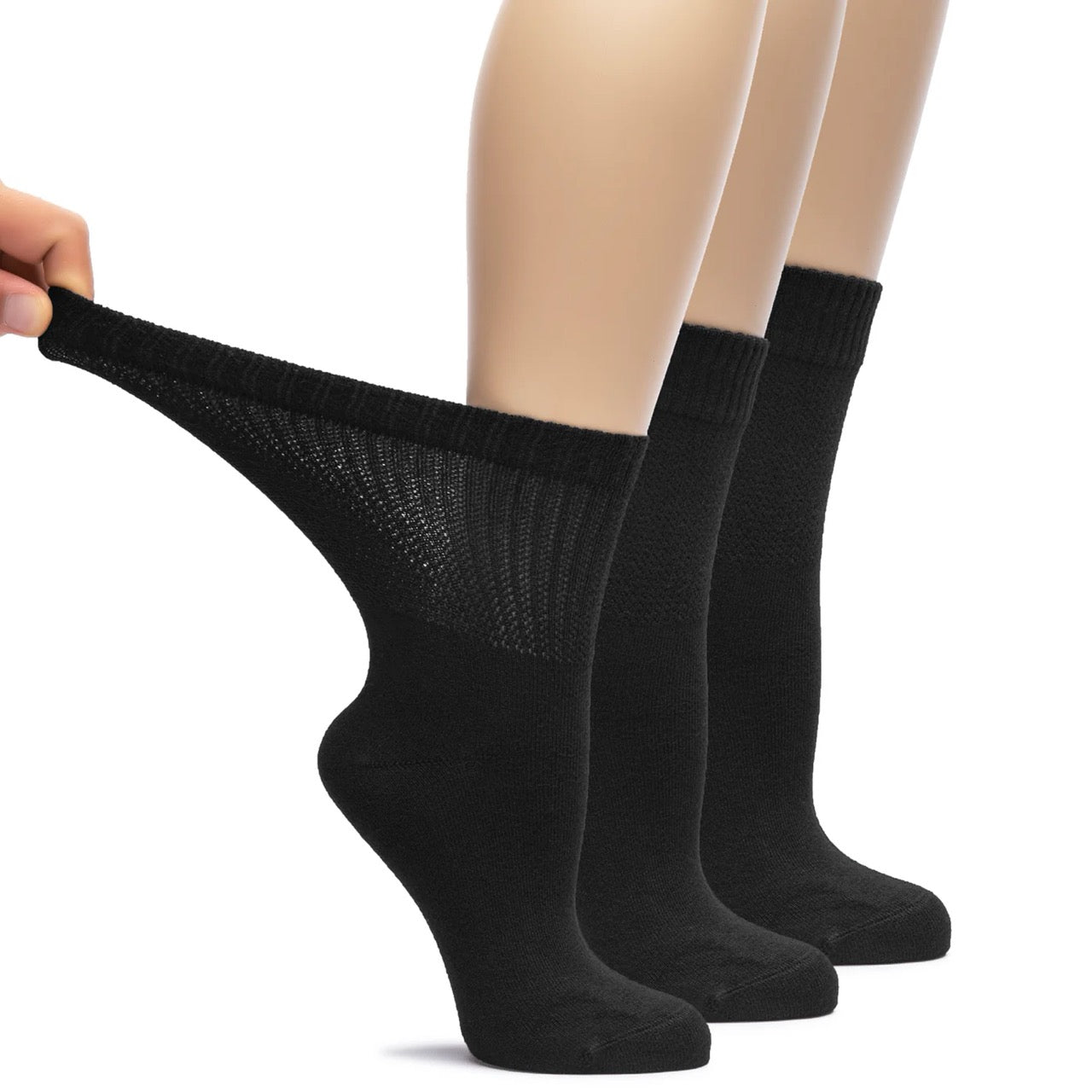
A non-binding sock is specifically designed to hold the sock in position without creating this constriction effect. The cuff holds the sock up through a combination of a wider band and gentler elastic tension that distributes any pressure over a larger area rather than concentrating it at the ankle. Look for product descriptions that explicitly state "non-binding top," "non-constricting cuff," "loose top," or "wide band" — these are the terms that indicate the cuff was designed with this concern in mind.
In lymphedema affecting the foot, the toes and toe joints are often among the most involved areas. The raised ridge of a standard toe seam, sitting perpendicular to the toe tips, creates localized pressure that is typically unnoticed in a foot with normal tissue volume but may become a source of irritation and potential skin breakdown in a foot that is edematous. A seamless toe construction — where the toe is closed without a raised perpendicular seam — eliminates this pressure point.
Seamless toe construction is also relevant because skin integrity concerns are often heightened in lymphedematous tissue. The slower-healing tendency associated with lymphedema means that pressure-related skin changes, even from something as minor as an ill-positioned sock seam, may take longer to resolve than they would in tissue with normal fluid balance and circulation. Eliminating unnecessary pressure points is a basic protective measure.
Skin integrity in lymphedema is a significant concern. Lymphedematous skin may be more susceptible to breakdown, fungal infection, and secondary infection — conditions that, in the context of already-compromised lymphatic drainage, can trigger significant flares. Maintaining a dry skin environment in the foot may help reduce the risk of moisture-related skin issues developing.
Moisture-wicking fibers — particularly bamboo viscose — actively draw perspiration away from the skin and move it toward the outer surface of the sock where it can evaporate. This may help keep the foot dryer than a cotton sock would, which matters both for skin integrity and for overall comfort during the extended daily wear that lymphedema management often involves.
Any interior texture that creates friction against edematous skin may increase the risk of skin irritation and breakdown. A sock with a smooth, flat interior without raised ribs, rough loops, or uneven knit structure is preferable to a cushioned or ribbed interior for lymphedematous feet. The interior surface in contact with the skin should be as smooth as possible — the priority is minimizing mechanical stress on skin that may already be under physiological stress.
A sock that's too large creates fabric wrinkles inside the shoe that generate localized pressure and friction. For a person with lymphedema, this is particularly relevant because the foot's volume may change throughout the day — typically larger in the afternoon and evening than in the morning — and a sock that fits in the morning may become too snug as the day progresses. Managing this requires adjusting sock selection or having options available for different times of day. A certified lymphedema therapist can provide specific guidance based on the degree of volume fluctuation in a particular patient's affected limb.
Several common sock features are particularly problematic for people with lower-limb lymphedema.
As discussed, standard sock elastic creates circumferential constriction at the ankle. This is the feature most directly problematic for lymphedema management and the one most worth prioritizing in sock selection. A sock with standard tight elastic — regardless of how well it performs in other respects — is not appropriate as an everyday sock for lower-limb lymphedema without guidance from a treating clinician confirming that the level of compression is acceptable in the specific clinical context.
Raised ribbing, terry loop cushioning, or other textured interior constructions may create additional friction against edematous skin. The skin of a lymphedematous foot may be more vulnerable to irritation; adding mechanical texture increases the risk of friction-related skin changes.
Over-the-counter compression socks and knee-high compression socks are widely marketed for swelling, circulation, and tired legs. For some types of swelling — dependent edema from prolonged sitting or standing — they may be helpful. For lymphedema specifically, compression garment use should be guided by trained professional assessment, because the wrong compression level, the wrong garment type, or an improperly fitted garment can worsen rather than help lymphedema. The Lymphatic Education & Research Network consistently emphasizes that lymphedema management should be directed by a certified lymphedema therapist, not self-directed based on product marketing.
Beyond the toe seam, seams at the heel or ankle that create pressure points on edematous tissue are also worth avoiding. Evaluate the interior construction of any sock intended for daily wear with lymphedema — seams at the heel cup, reinforcement ridges at the heel or ankle, or any feature that creates a distinct pressure band are less suitable than a smooth-interior, non-binding alternative.
Some people with lymphedema wear thin socks under their compression stockings or wrapping to protect the skin from friction during donning and doffing, to provide an additional moisture-wicking layer, or for basic warmth. In this context, the sock must be thin enough not to create bulk under the compression garment, smooth enough not to create internal friction, and non-binding at the cuff so as not to create a pressure ring that becomes concentrated when the compression garment is applied over it.
Thin, flat-knit socks in smooth natural fibers — particularly bamboo viscose — are commonly used for this purpose because they add minimal bulk, have good moisture-wicking properties, and have a smooth interior that doesn't create friction against the skin beneath a compression garment. The non-binding cuff in this application prevents the sock cuff from creating a constriction point that would then be compressed further by the compression garment worn over it.
For people with lower-limb lymphedema looking for an appropriate everyday sock — worn during low-activity periods, during sleep on advice of their therapist, or under compression garments — the most relevant features align with those designed into socks for people with diabetes, because the underlying concern is similar: avoiding constriction at the ankle, eliminating toe pressure, and maintaining a moisture-managed skin environment.
A thin bamboo ankle sock with a non-binding top and seamless toe provides the combination of features most relevant to this context: no ankle constriction from the cuff, no toe seam pressure, bamboo fiber's moisture-wicking properties, and a thin enough profile to wear under compression garments without creating excess bulk. For men, a bamboo ankle sock with non-binding construction provides the same features in a men's fit. These are not compression garments and are not a substitute for medically indicated compression therapy — they are everyday socks designed to avoid the features that are most problematic for lymphedematous tissue. Always confirm appropriate footwear choices with your certified lymphedema therapist.
Most decisions about footwear and compression management in lymphedema should involve a certified lymphedema therapist. A CLT can assess the stage and severity of lymphedema, determine what compression class is appropriate, fit compression garments correctly, and advise on daily management including what to wear and when. The Lymphatic Education & Research Network maintains resources for finding certified therapists and provides patient education materials on lymphedema management.
For people who have not yet been evaluated for lymphedema but are experiencing persistent swelling in one or both legs, unexplained heaviness or tightness in the limb, or recurring skin changes, evaluation by a healthcare provider is the first step. Lymphedema is a manageable but progressive condition — early intervention is commonly associated with better outcomes than delayed treatment.
For people managing lower-limb lymphedema, sock selection is more consequential than it is for most wearers. The features most likely to cause problems — standard elastic cuffs, rough interiors, standard toe seams — are present in most socks and create pressure or friction on tissue that may already be physiologically stressed. The features most likely to be appropriate — non-binding tops, seamless toes, smooth bamboo or similar fiber interiors — are found in socks designed with foot health considerations in mind. What's appropriate for a specific person's situation depends on the presentation of their lymphedema, what treatment they're undertaking, and the guidance of their certified lymphedema therapist. This article provides general orientation; clinical guidance provides the specific answer for each individual.
This article is for general information and is not medical advice. Talk to your healthcare provider about your own feet. If you have lymphedema, please work with a certified lymphedema therapist for personalized management guidance.
People with lower-limb lymphedema commonly benefit from socks with non-binding, non-constricting tops that hold the sock in position without creating circumferential pressure at the ankle; seamless toe construction to avoid pressure on edematous toe tissue; smooth interiors that minimize friction against sensitive skin; and moisture-wicking fibers that may help maintain dry skin conditions. The specific type of sock appropriate for a given person's situation — including whether and what type of compression garment should be worn — should be determined in consultation with a certified lymphedema therapist.
Yes, and the difference matters. Compression socks in the medical sense are graduated compression garments — prescribed or recommended by a healthcare provider, measured to specific mmHg pressure classes, and fitted to individual limb measurements — that are a core component of lymphedema treatment. "Lymphedema socks" as a consumer label may refer to either these medical compression garments or to everyday socks marketed for people with swollen feet. The term is not standardized. The key distinction is whether a product is a calibrated compression garment (appropriate for lymphedema treatment only under professional guidance) or an everyday sock designed to avoid constriction.
Standard socks with tight elastic cuffs create circumferential ankle constriction that may impede lymphatic flow — the same type of constriction that lymphedema management tries to avoid creating. Wearing socks with standard elastic over a period of time during active lymphedema may contribute to fluid accumulation in the foot and ankle that works against concurrent treatment. This is why non-binding top construction is the most important feature to look for in everyday socks worn by people with lymphedema. A certified lymphedema therapist can advise on what specific sock and compression combinations are appropriate for an individual's condition and treatment phase.
Whether to wear socks — or compression garments — during sleep for lymphedema management depends on the individual's treatment protocol, condition severity, and the specific guidance of their certified lymphedema therapist. Some therapists recommend a lighter compression garment during sleep for patients with significant overnight fluid accumulation; others do not. For people advised to wear something during sleep, a thin, non-binding sock may be appropriate to maintain basic warmth and skin protection. This is an individual clinical decision — work with a certified lymphedema therapist for advice specific to your situation.
Bamboo viscose is often recommended for people with lymphedema because it combines moisture-wicking properties — actively moving perspiration away from the skin — with a smooth, fine-fiber texture that minimizes friction against sensitive or fragile skin. Maintaining dry skin conditions may help support skin integrity, which is an important concern in lymphedematous tissue. Merino wool also has good moisture-wicking properties, though some people find it warmer than desired. Synthetic fibers that don't breathe well or retain moisture, and rough or heavily textured natural fibers that increase friction, are generally less suitable.
He has been working for more than 20 years in the textile industry and has work experience in many parts of the world.