Cart
0
You may also like


If you have visible varicose veins and your legs ache by the end of the day, the sock aisle is confusing in a specific way. One shelf offers graduated compression rated in mmHg. Another offers non-binding socks that promise not to squeeze at all. Both are marketed to people with tired, heavy legs, and the two things appear to be opposites.
They are not opposites. They do different jobs, and which one belongs on your feet depends on what is bothering you, what a clinician has said, and in many cases what time of day it is. This article explains what varicose veins are, what compression is actually for, where non-binding socks fit, and how to decide between them without guessing.
Leg veins carry blood upwards against gravity, and they rely on one-way valves plus the pumping action of the calf muscles to do it. When those valves stop closing properly, blood pools rather than moving on, pressure rises in the vein, and the vessel widens and becomes visible under the skin.
The Society for Vascular Surgery describes varicose veins as swollen, twisted veins under the skin of the legs, caused by raised pressure inside the vein when the valves are damaged. Mayo Clinic's overview notes that legs are affected most often because standing and walking increase pressure in the lower body veins, and lists aching, heaviness, cramping and swelling in the lower legs among the common symptoms, along with discomfort that worsens after long periods of sitting or standing.
Two features of that description matter for the sock question. First, this is a pressure problem, not a friction problem. Second, symptoms tend to build across the day — which is exactly the pattern that a well-fitted garment can act on, and exactly the pattern that a badly-fitted one can make worse.
Graduated compression socks apply the most pressure at the ankle and progressively less as they go up the leg. That gradient is the whole point: it encourages blood to move upwards rather than pool, and supports the calf-muscle pump.
Cleveland Clinic's overview of compression therapy describes it as a conservative first-line option in chronic venous insufficiency and varicose veins, working by squeezing the leg to support the return of blood towards the heart, and notes that properly fitted medical-grade stockings are particularly useful when veins are causing painful or uncomfortable symptoms. The Society for Vascular Surgery's patient guidance points to knee-high stockings in the 20–30 mmHg range as a level that may help relieve aching and swelling by limiting pooling in the leg veins.
Cleveland Clinic also makes a point that gets skipped in most product listings: ask a healthcare provider before using compression stockings, bandages or wraps, because they will advise on the pressure level that is safe and useful for you. That caveat is not boilerplate. Compression is a therapeutic intervention with situations in which it is not appropriate — significant arterial disease being the most important — and the right class is a clinical judgement, not a shelf-browsing one.
Higher is not better. A stocking that is too firm for your circulation, or that has been sized by guesswork, can be uncomfortable at best. If compression is on the table, get measured — the numbers only mean anything if the garment actually fits the leg.

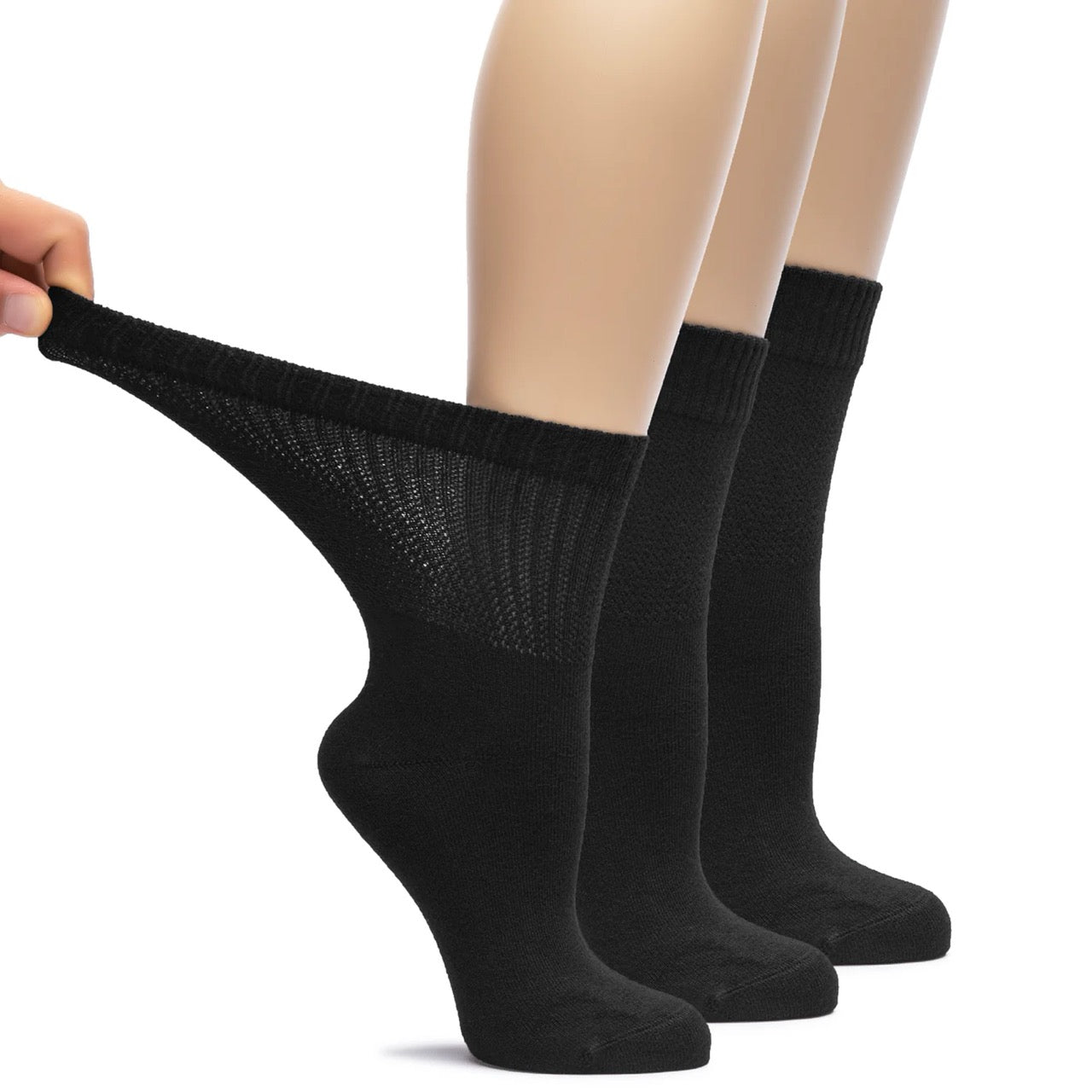
A non-binding sock is not compression at a lower number. It is a different design intent altogether. Instead of applying a pressure gradient, it aims to apply as little localised pressure as possible — the cuff holds the sock up through the structure of the knit and a wide, gentle band rather than a tight elastic ring, so it does not constrict the calf at a single point.
This matters for varicose veins for a specific reason. An ordinary sock cuff creates a tight band around a limb where venous return is already compromised. That is the opposite of graduated: the pressure is highest at the top of the calf rather than at the ankle, which is the wrong direction. The deep ring marks that many people notice above the ankle at the end of the day are the visible version of this. Our article on why some socks feel too tight around the calf covers the mechanics in more detail.
Non-binding socks are designed to remove that band. They are not a substitute for compression therapy where compression has been recommended, and nobody should present them as one. What they are is a much better default sock for the other twenty hours of the day.
The honest framing is that this is often not an either/or.
That last group is not a formality. Compression relies on adequate arterial supply to be safe, and reduced sensation makes it harder to notice a garment that is too tight.
Assuming a non-binding sock is what you want, the construction details that matter are:
Men's options in the same construction are in the lightweight bamboo ankle style, and the wider range is in our diabetic and non-binding socks collection.
Most of the people who ask this question end up somewhere in the middle, and it helps to see what that looks like across a day rather than as a single purchase decision.
A common pattern for someone who has been advised to use compression is: put the compression stockings on first thing, before getting out of bed if possible, while the legs are at their least swollen. Wear them through the working day. Take them off in the evening, and switch to a soft non-binding sock for the hours at home and overnight. The compression garment does its work during the upright hours; the non-binding sock keeps the leg comfortable and warm for the rest without adding a constriction band.
For someone who has not been advised to use compression and is simply dealing with visible veins and tired legs, the pattern is simpler: non-binding socks all day, calf movement built into any long period of sitting or standing, and legs elevated in the evening. If symptoms are getting worse rather than staying steady, that is the trigger for a conversation rather than a different sock.
One thing worth flagging: legs are not the same size at 8am and 6pm. If you buy socks in the morning by how they feel and they cut in by evening, the sock is not necessarily wrong for you — it is sized for the wrong end of the day. Sizing for the larger evening measurement, and choosing a cuff that can accommodate the difference, avoids the most common source of dissatisfaction here.
Sock construction is one variable among several, and the others are free.
Related reading: our guide to the role of socks in managing swelling, our explanation of how non-binding socks support circulation, and — if you travel — our look at compression socks on long flights.
They serve different purposes. Graduated compression is the option clinicians most often discuss for symptomatic varicose veins, because it applies a pressure gradient designed to limit pooling in the leg veins. Non-binding socks do not apply a gradient — they are designed to avoid creating a tight band at the calf, which makes them a comfortable everyday choice, including for the hours when compression garments are off. Which is right for you is a question for your clinician, particularly if you have any arterial circulation concerns.
Patient guidance from the Society for Vascular Surgery points to knee-high stockings around 20–30 mmHg as a level that may help relieve aching and swelling. That is a general reference point rather than a recommendation for any individual — the appropriate class depends on your circulation, your symptoms and proper measurement, so it should be set with a healthcare provider.
A tight cuff creates a constriction band at the top of the calf, which is the opposite of the graduated pattern compression garments are built around. Many people find that ordinary elastic cuffs leave deep marks and add to end-of-day discomfort. Whether that influences the underlying vein disease is not something a sock choice determines, but a non-binding cuff is a more comfortable option and removes an unnecessary pressure point.
Compression garments are generally worn during waking hours and removed at night unless a clinician has specifically advised otherwise, since the benefit relates to being upright against gravity. A soft non-binding sock is the usual choice for overnight warmth. Follow whatever instruction your own provider has given you.
They do not actively move fluid the way graduated compression is designed to. What they do is accommodate a leg whose circumference changes through the day without cutting in, which many people find noticeably more comfortable. If swelling is new, one-sided, or came on suddenly, that warrants medical assessment rather than a change of sock.
This article is for general information and is not medical advice. Talk to your healthcare provider about your own feet.
He has been working for more than 20 years in the textile industry and has work experience in many parts of the world.