Cart
0
You may also like


If you've ever put on a pair of shoes in the morning and found them comfortably loose, only to notice them feeling noticeably tighter by late afternoon, you've experienced foot expansion firsthand. It isn't a quirk or a sign that something is wrong. It's a predictable, physiological process that happens to almost everyone to some degree — and understanding why it happens makes it easier to make better decisions about shoes, socks, and how you manage your feet across a long day.
Feet don't expand randomly. The amount of swelling, when it occurs, and how pronounced it becomes are all shaped by a specific set of factors: gravity, temperature, activity level, and the body's fluid management systems. Each of these operates in a consistent and predictable way, and together they explain why the foot you have at 8am is measurably different from the foot you have at 5pm.
The underlying process is a combination of fluid dynamics and the body's circulatory response to upright posture and physical activity. When you stand or walk, your heart pumps blood downward into the legs and feet with relative ease — gravity assists that direction of travel. The return journey, moving blood back upward through the venous system against gravity, requires more work from the muscles and vascular valves that help push blood upward through the legs.
Over the course of the day, this asymmetry causes a net accumulation of fluid in the lower extremities. Blood plasma leaks slightly from the capillaries into the surrounding tissue — a normal, low-level process that is part of how nutrients reach cells. The lymphatic system and the venous return system clear this fluid back into circulation, but when you're upright and active for many hours, the clearance rate doesn't always keep up with the rate of accumulation. The result is a gradual increase in fluid volume in the soft tissues of the foot and ankle, which translates directly into a measurable increase in foot dimensions.
This process is not pathological — it's the normal response of a human body to being upright for an extended period. It becomes more pronounced under certain conditions, and in certain people it may occur to a degree that warrants medical attention, but for the majority of people experiencing modest afternoon foot expansion, it is simply the body doing what bodies do.
The gravitational component of foot expansion is why the phenomenon is almost universal among people who spend significant time on their feet or seated with their legs down, and much less pronounced among people who are lying flat or have their legs elevated for most of the day. Gravity pulls fluid toward the lowest point it can reach, and for most people in most daily positions, that lowest point is the foot.
This is also why foot swelling tends to reverse relatively quickly when you lie down or elevate your legs. The hydrostatic pressure that drives fluid out of capillaries and into tissue decreases when the foot is at the same level as the heart, and the venous return system can clear the accumulated fluid much more efficiently. Many people notice that shoes that felt tight in the evening feel loose again by the next morning — not because the shoe changed, but because overnight recumbency allowed the foot to return close to its morning baseline volume.
The practical implication of this is that foot measurements taken in the morning are not representative of the foot at its working size. Podiatrists and footwear specialists have long recommended buying shoes in the afternoon or evening for this reason — the foot you're fitting at that time of day is closer to the size you'll need when the shoe is doing most of its work.

Temperature is one of the most significant accelerators of daily foot expansion. Heat causes blood vessels to dilate — a process called vasodilation — which increases blood flow to the skin and extremities as part of the body's thermoregulation response. More blood flowing to the feet means more fluid pressure in the capillaries, which means more fluid leaking into the surrounding tissue and faster accumulation of volume.
This is why feet expand more dramatically in summer than in winter, and why a day spent outdoors in warm weather produces noticeably more foot swelling than an equivalent day indoors in a climate-controlled environment. The effect is compounded by the fact that warm conditions also encourage more sweating, which changes the moisture environment inside the shoe and can make the sock and shoe lining feel tighter as they absorb moisture and swell slightly themselves.
People who travel to hot climates and find that shoes that fit fine at home feel uncomfortably tight after a day of warm-weather sightseeing are experiencing exactly this mechanism. The foot that gets on the plane fits the shoe. The foot that has spent six hours walking in 30-degree heat is measurably larger, and the shoe's interior dimensions haven't changed to accommodate it.
Activity level influences foot expansion in two distinct ways, and they work in partially opposite directions.
On one hand, walking and standing increase the mechanical load on the foot, which increases the rate at which fluid is pushed out of blood vessels and into surrounding tissue. More steps mean more compression of the foot's structures, more heat generated locally, and more fluid accumulation over time. A day of heavy walking produces more foot expansion than a day of sitting.
On the other hand, active muscle contractions in the calf and foot during walking actually assist venous return — the muscular pumping action helps push blood back toward the heart, partially counteracting the fluid accumulation that gravity and capillary pressure drive. This is why extended sitting, particularly in positions where the legs are dependent and the calf muscles are inactive, can sometimes produce more foot and ankle swelling than moderate walking. The muscles aren't pumping. Fluid accumulates, and there's less active assistance moving it back out.
The worst combination for foot expansion tends to be standing still for long periods — retail work, events where you're on your feet but not moving much, long flights where you're seated without being able to walk. In these contexts, both gravitational pressure and minimal muscular pumping work together to accelerate fluid accumulation.
The amount varies considerably between individuals and depends on the factors described above, but the range that most people fall into is significant enough to matter practically. Studies measuring foot volume across the day consistently find that the average person's foot increases in volume by between five and eight percent from morning to evening under normal daily conditions. In warmer conditions or after a high-activity day, increases of ten percent or more are common.
In terms of shoe size, a foot that has expanded by its typical daily amount may have increased by anywhere from a quarter to a full size in effective length, and by a proportionate amount in width. This is enough to make a snugly fitted morning shoe uncomfortable by afternoon, and enough to make a correctly fitted afternoon shoe feel loose when you try it on first thing in the morning.
Width expansion tends to be more pronounced than length expansion, because the soft tissues of the forefoot and the spaces between the metatarsals can swell more freely than the overall length of the foot, which is constrained by its bony structure. This is why the shoe tightness that people notice most often in the afternoon is across the forefoot rather than at the toe — the widening of the foot is pressing against the sides of the shoe.
The daily foot expansion described here is normal and expected. There are, however, patterns of foot and ankle swelling that fall outside the range of normal daily variation and may be worth discussing with a healthcare professional.
Swelling that is pronounced primarily in one foot rather than both symmetrically, swelling that doesn't reduce overnight after a period of rest and elevation, swelling accompanied by redness, warmth, or pain in a specific area, or swelling that has noticeably worsened over a short period of time are all patterns that many healthcare professionals commonly recommend having assessed. These presentations can be associated with conditions ranging from local injury to circulatory issues that benefit from professional evaluation. Anyone noticing these patterns is encouraged to consult with their doctor rather than attributing them to normal daily variation.
Similarly, people managing conditions that affect fluid balance — including heart conditions, kidney conditions, thyroid disorders, or venous insufficiency — may experience foot swelling that goes beyond the typical daily range. The management of swelling in these contexts is specific to the underlying condition and should be guided by a healthcare professional familiar with the individual's situation.
The practical implication of daily foot expansion for shoe purchasing is straightforward once you understand the mechanism. Shopping for shoes in the morning, when the foot is at its smallest, risks buying shoes that will be uncomfortable by the time they're doing most of their work. Shopping in the afternoon or evening, or after a period of activity, gives a more accurate picture of the foot's working size.
Buying both feet rather than just the dominant foot is equally important, because feet are often not exactly symmetrical in size. Fitting the larger foot ensures neither shoe is uncomfortably tight by the end of the day. The smaller foot in a shoe fitted to the larger foot will still be comfortable — a slightly loose shoe is less problematic than a tight one.
For people who find that shoe fit varies significantly between morning and evening — particularly those who spend long hours on their feet in demanding conditions — choosing shoes with some degree of adjustability (laces rather than slip-ons, for example) gives more flexibility to accommodate the foot at different points in its daily expansion cycle. A lace-up shoe can be worn slightly looser in the morning and adjusted as the day progresses, in a way that a fixed-opening shoe cannot.
Socks interact with daily foot expansion in ways that are worth understanding, because the sock is in direct contact with the foot at all times and its construction directly affects how comfortable foot expansion feels across the day.
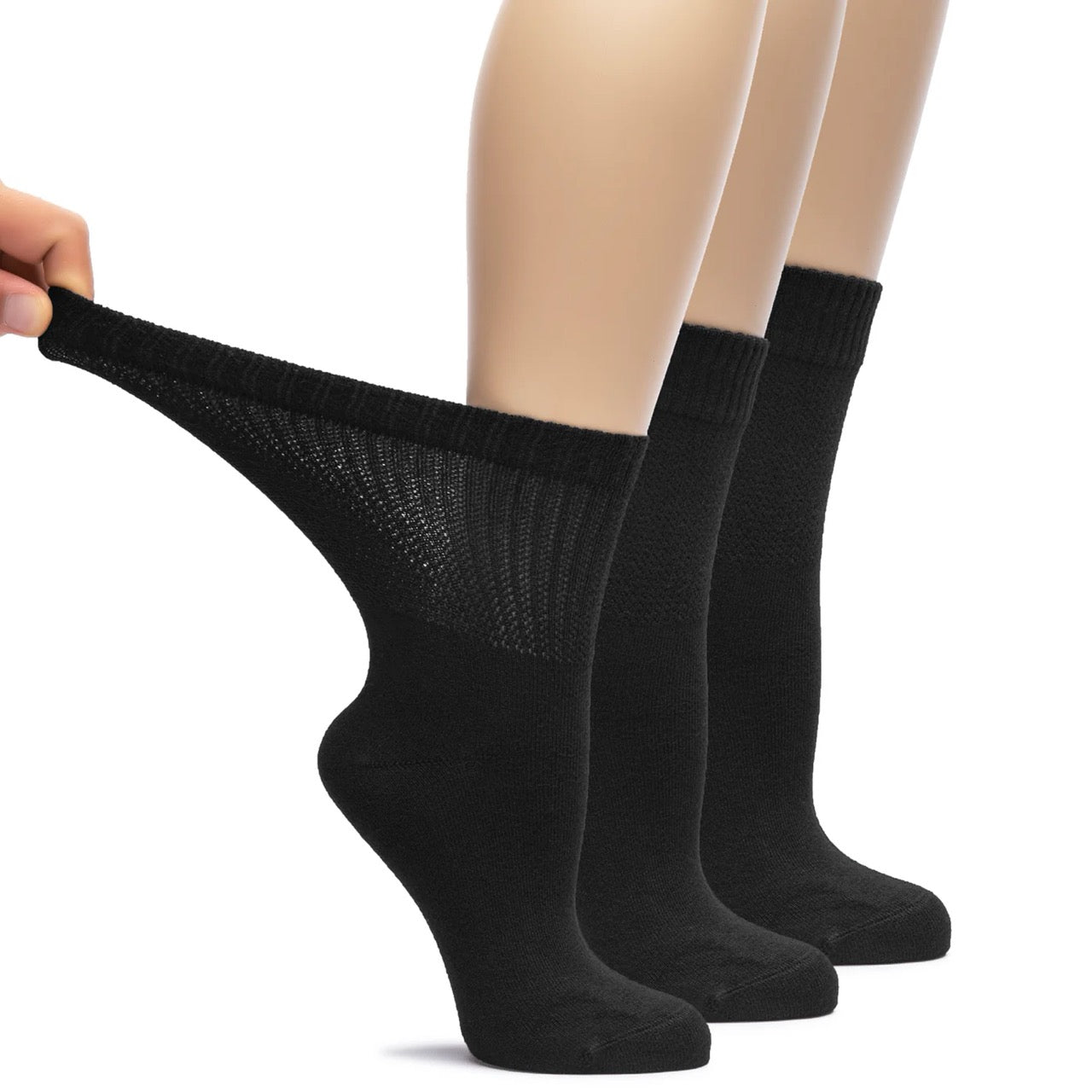
The cuff is the most significant consideration. A sock with a tight, restrictive elastic cuff creates a constriction point at the ankle that doesn't accommodate expansion well. As the foot and lower leg swell slightly over the course of the day, a tight cuff becomes progressively more noticeable — and for people with meaningful daily foot expansion, it can shift from mildly constricting to genuinely uncomfortable by late afternoon. A bamboo ankle sock with a non-binding top holds the sock in place without the kind of inward pressure that becomes more apparent as the leg's volume increases through the day — making it a more comfortable choice across the full arc of daily wear, not just in the morning.
The same principle applies for men. A bamboo ankle sock designed with a gentle, non-binding cuff accommodates natural daily volume changes without creating a pressure point that the foot and lower leg progressively push against. For people who spend long days on their feet or who notice sock marks at the end of the day, this is often the specific construction detail that makes the most noticeable difference.
Fabric elasticity through the body of the sock also matters. A sock constructed from a fabric with some inherent stretch — bamboo, which has natural give, or a quality blend with stretch fibers — accommodates forefoot widening more comfortably than a rigid knit that doesn't yield as the foot broadens across the day. The sock that fits well in the morning and still feels comfortable at the end of the day is one that was designed with some accommodation of this expansion built into its construction.
For people who experience significant daily foot expansion or who spend long hours on their feet, a few consistent habits can reduce the degree of swelling and improve how feet feel across a long day.
Moving regularly rather than standing still is one of the most effective. Even short periods of walking activate the calf muscle pump and assist venous return, reducing the rate of fluid accumulation compared to static standing. Elevating the feet during breaks — raising them above the level of the heart, even briefly — allows gravity to assist fluid drainage rather than drive fluid accumulation, and can produce a noticeable reduction in foot volume over a relatively short rest period.
Staying well hydrated, counterintuitively, tends to reduce rather than increase fluid retention. Dehydration can trigger the body's fluid conservation mechanisms, which cause the body to retain more fluid in tissue rather than circulating and clearing it efficiently. Adequate hydration supports the normal fluid balance processes that keep tissue swelling within the expected range.
In warm conditions, keeping the body temperature managed where possible reduces the vasodilation contribution to foot expansion. Working in air conditioning, taking breaks in cooler environments, and choosing breathable footwear and socks that don't trap additional heat against the foot all help limit the temperature-driven component of daily swelling.
Foot expansion throughout the day is a normal, predictable consequence of being upright. Gravity drives fluid toward the feet, heat accelerates the process, activity patterns modify it in both directions, and the cumulative result is a foot that is measurably larger in the evening than it was in the morning. Understanding this pattern explains why shoes feel different at different times of day, why afternoon is the better time to buy footwear, and why the design details in socks — particularly cuff construction and fabric elasticity — matter more than they might seem at first glance. Managing these factors sensibly produces noticeably more comfortable feet across the whole of a long day, not just at the start of it.
Feet swell during the day primarily because of gravity and the body's fluid dynamics. When you're upright, blood and fluid are pulled toward the lower extremities, and the fluid that leaks from capillaries into surrounding tissue accumulates faster than the venous and lymphatic systems can clear it. Heat accelerates the process by dilating blood vessels and increasing fluid pressure in the capillaries. The result is a gradual increase in foot volume across the day that is normal and expected for most people.
Most people's feet increase in volume by approximately five to eight percent between morning and evening under typical conditions. In warmer weather or after a particularly active or sedentary day, increases of ten percent or more are common. In practical terms, this can amount to a quarter to a full shoe size increase in effective fit, which is enough to make a correctly fitting morning shoe feel tight by the afternoon.
Modest, symmetrical foot and ankle swelling that develops over the course of the day and reduces after a night of rest is a normal physiological response to upright posture and activity. It is experienced by the majority of people to some degree. Swelling that is one-sided, doesn't reduce overnight, is accompanied by pain, warmth, or redness, or has significantly worsened recently is worth discussing with a healthcare professional, as these patterns can indicate conditions that benefit from assessment.
The afternoon or evening is generally recommended as the best time to buy shoes, because the foot has expanded closer to its working size by that point in the day. Buying shoes in the morning risks fitting a foot that is smaller than it will be when the shoes are doing most of their work. Trying on both feet and fitting to the larger foot also helps ensure comfortable wear across a full day.
Socks with a non-binding, gentle cuff are particularly well suited for people whose feet and lower legs expand noticeably through the day. A tight elastic cuff becomes progressively more constricting as the leg's volume increases, and can leave marks or cause discomfort by late afternoon. Socks made from naturally stretchy fibers like bamboo accommodate forefoot widening more comfortably than rigid constructions. A bamboo sock with a non-binding top provides both the fabric flexibility and the cuff design that work best with natural daily foot expansion.
He has been working for more than 20 years in the textile industry and has work experience in many parts of the world.