Cart
0
You may also like


Partly, and the distinction matters. A Cochrane review of nine randomised trials found that airline passengers wearing compression stockings on flights of four hours or more developed substantially fewer symptomless clots detected by ultrasound screening, and had less leg swelling. What the trials could not show is any effect on pulmonary embolism or symptomatic DVT, because no such events occurred in any of them. So the honest claim is narrower than the marketing: compression reduces screening-detected clots and swelling, and moving regularly remains the more important habit for most healthy travellers.
Key Takeaways
Search for anything about long-haul flights and you will find the same advice repeated everywhere: wear compression socks. It is offered so confidently that most travellers never ask what the evidence behind it actually says, or whether the pair they grabbed at the airport is doing anything at all.
The short version is that the evidence is real, more specific than the marketing suggests, and easy to misread. Compression stockings have been studied in airline passengers in randomised trials, and the results are worth knowing before your next long flight — particularly the difference between the outcome that was measured and the outcome most people assume was measured.
This guide walks through what deep vein thrombosis is, what the research found, who is likely to benefit, what the graduated compression numbers mean, and what to wear if compression is not right for you.
Deep vein thrombosis is a blood clot that forms in one of the deep veins, most often in the leg. The concern with a clot in that location is that part of it can break away and travel to the lungs, which is called a pulmonary embolism. This is uncommon, but it is serious enough that the risk factors are worth taking seriously.
Travel comes into it because of immobility, not altitude. According to the CDC's guidance on blood clots during travel, anyone travelling more than about four hours — by plane, car, bus or train — has some increase in risk, and the longer you stay still, the more that risk climbs. A cramped economy seat does not create a special aviation hazard; it creates several hours of sitting with bent knees and very little calf muscle activity.
For most healthy travellers on a short flight, the absolute risk is very low. For someone with several of the factors above on a twelve-hour flight, the calculation is different — and that is the person the research is most relevant to. The NHS overview of DVT is a good plain-language summary of the symptoms to know: swelling in one leg, a heavy ache, warmth, and skin that looks red or darker than usual.
The central piece of evidence here is a Cochrane systematic review of compression stockings in airline passengers, which pooled nine randomised trials covering more than two thousand people on flights of at least four hours.
The review's findings are clear on one outcome and silent on another, and this distinction is the whole point:
That last line is the one that gets lost. The trials measured clots found by ultrasound screening in people who had no symptoms. They did not, and could not, demonstrate that stockings stop the rare, dangerous outcomes — you would need an enormous study population to detect an event that infrequent.
The accurate answer is that the evidence shows fewer symptomless clots among stocking wearers on long flights, and the evidence base does not extend to serious events like pulmonary embolism. That is a meaningful finding — it is just narrower than "compression socks prevent DVT," which is the version that ends up in headlines and product copy.
For a traveller weighing it up: if you have elevated risk and a long flight, graduated compression is a low-cost, low-downside measure that has genuine evidence behind it. If you are a healthy traveller on a five-hour hop, moving regularly is the more important habit, and comfortable non-restrictive socks will serve you better than a tight pair you spend the flight wanting to remove.
Graduated compression means the pressure is highest at the ankle and decreases up the leg, which is what encourages blood to move upward. Pressure is measured in millimetres of mercury, usually written mmHg.
UK vascular guidance for travellers points to well-fitted below-knee hosiery in the 15–30 mmHg range at the ankle for those at moderate or higher risk. Two practical notes: the pressure only works if the stocking fits, so measure your ankle and calf rather than buying by shoe size alone, and compression is not appropriate for everyone. Anyone with peripheral artery disease, significant neuropathy, or an open wound should ask a clinician before wearing compression at all.
If you are trying to work out how compression differs from the other categories of specialist sock, our comparison of compression socks and regular socks and the breakdown of diabetic socks versus compression socks both go into more depth.
A significant number of travellers should not be reaching for a firm compression stocking, and are better served by a sock that simply does not restrict the leg.
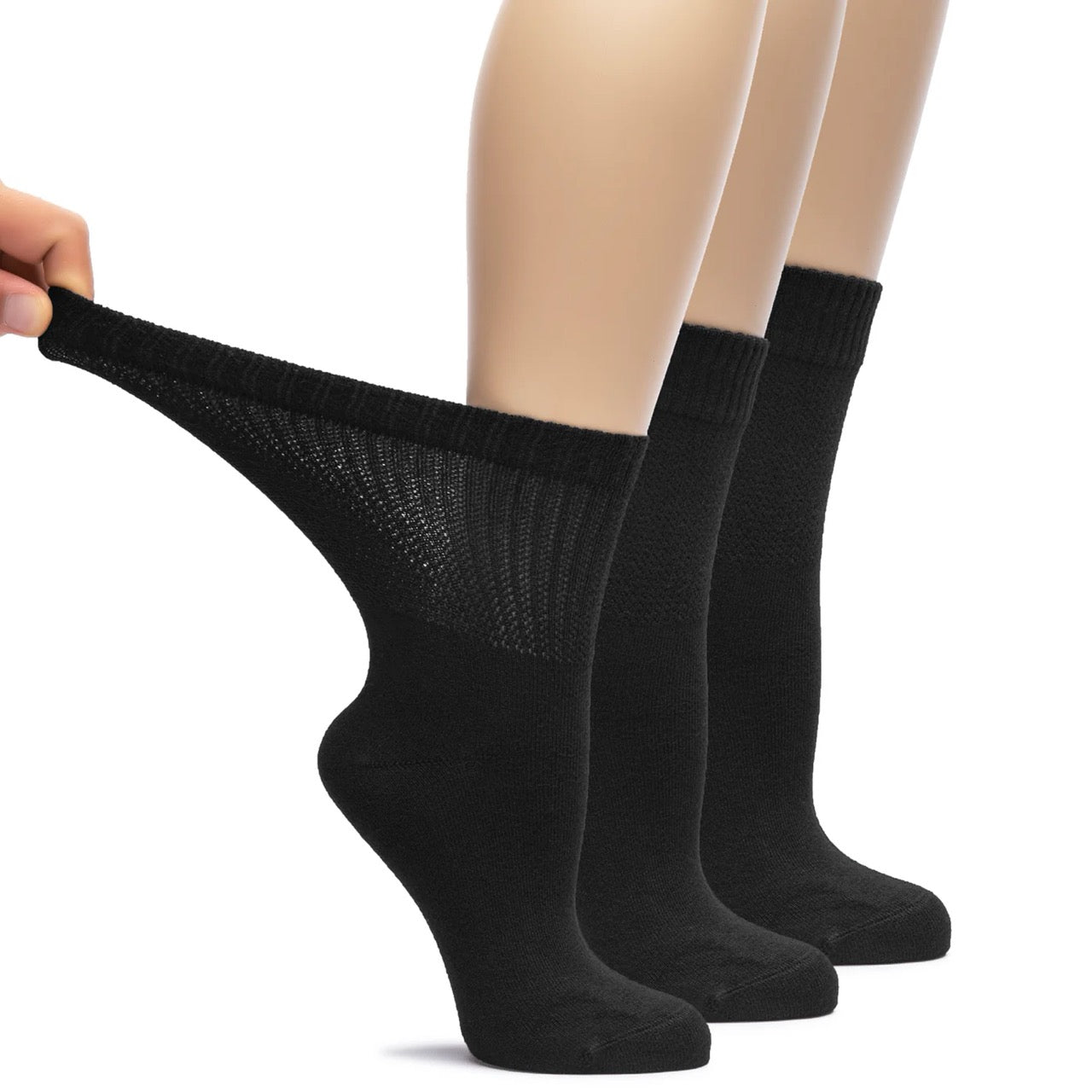
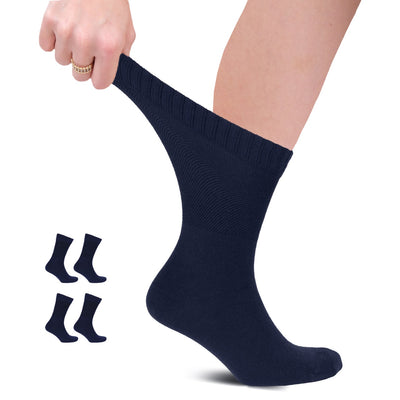
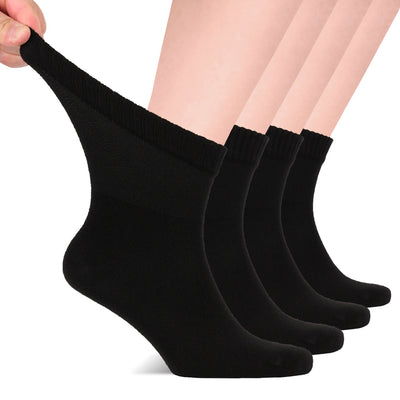
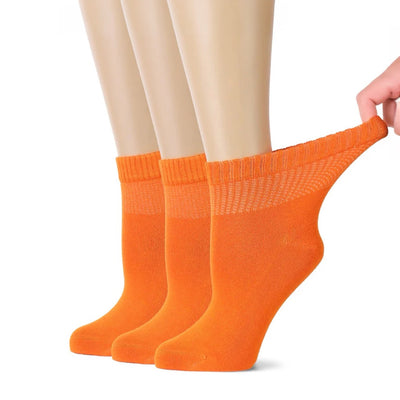
For all of these travellers, a well-made non-binding sock is the sensible default: no compression, no pressure ring at the cuff, and nothing that digs in over a long day of sitting. Our Unisex Cotton Diabetic Crew Socks and Men's Lightweight Bamboo Diabetic Ankle Socks are both built around a wide, gentle cuff and a seamless toe — the design is explained in why doctors recommend non-binding socks. For travellers whose ankles swell on long flights, the Women's Comfortable Diabetic Bamboo Ankle Socks for Swollen Legs are cut with extra room through the ankle and calf.

Whatever you decide about compression, the behavioural measures carry a lot of the weight and cost nothing.
Setting the compression question aside, a good travel sock does four things: it stays up without gripping, it does not press across the toes, it manages moisture through a long day in shoes, and it is comfortable enough that you forget it is there.
Our complete guide to travel socks compares fabrics and heights for different journey types, and the full range of non-binding options is in the diabetic and non-binding socks collection. If you spend the trip on your feet rather than in a seat, socks for all-day standing comfort is the more relevant read.
This article is for general information and is not medical advice. Talk to your healthcare provider about your own feet.
The Cochrane review of randomised trials found that airline passengers wearing compression stockings developed fewer symptomless clots detected on screening, and that leg swelling was reduced. The trials recorded no cases of pulmonary embolism or symptomatic DVT in either group, so the evidence does not extend to those serious outcomes. Compression is a reasonable measure for higher-risk travellers, but it is not a guarantee, and it does not replace moving regularly.
Travel hosiery is usually sold in the 15-20 mmHg range, and vascular guidance for travellers commonly points to 15-30 mmHg at the ankle for those at moderate or higher risk. Anything firmer is medical-grade and should be selected with a clinician. Fit matters as much as the number — measure your ankle and calf, because a stocking that does not fit does not deliver graduated pressure.
Ask your healthcare provider first. Reduced sensation means you may not feel a stocking that has rolled, bunched, or is too tight, and peripheral artery disease can make compression inappropriate. Many people with diabetes are better served on a flight by a non-binding sock with a seamless toe, which stays comfortable without applying pressure.
The CDC uses about four hours of travel as the point where risk begins to rise, regardless of whether you are in a plane, car, bus or train. Risk increases with duration and with individual factors, so a healthy traveller on a five-hour flight is in a very different position from someone with a previous clot on a fourteen-hour one.
No, and they work in opposite directions. Flight socks apply graduated compression to encourage blood flow upward. Diabetic and non-binding socks are designed specifically not to compress — the aim is a wide, gentle cuff, a seamless toe, and no pressure points on skin that may have reduced sensation. Wearing the wrong one for your situation is worth avoiding.
Discover All Hugh Ugoli Socks
Shop All Socks